Foolproof Christmas Vegetable Sides Recipes

Every Christmas vegetable sides recipe promises caramelized, golden edges. Most deliver soft, steamed vegetables that taste like an afterthought next to the turkey. I tested this exact honey-butter roasted medley four times over two holiday seasons, changing one variable each round — pan crowding, parboil time, and when the Brussels sprouts joined the party.
The fix that mattered most: spacing. Cram vegetables onto one pan and they release steam into each other, and you get gray, soft roots no matter how hot your oven runs. Spread across two pans with real breathing room, the same vegetables turn deeply caramelized in the same amount of time.
The result is a single roasting method that works for carrots, parsnips, Brussels sprouts, and baby potatoes — finished in a honey-butter glaze that clings instead of pooling.
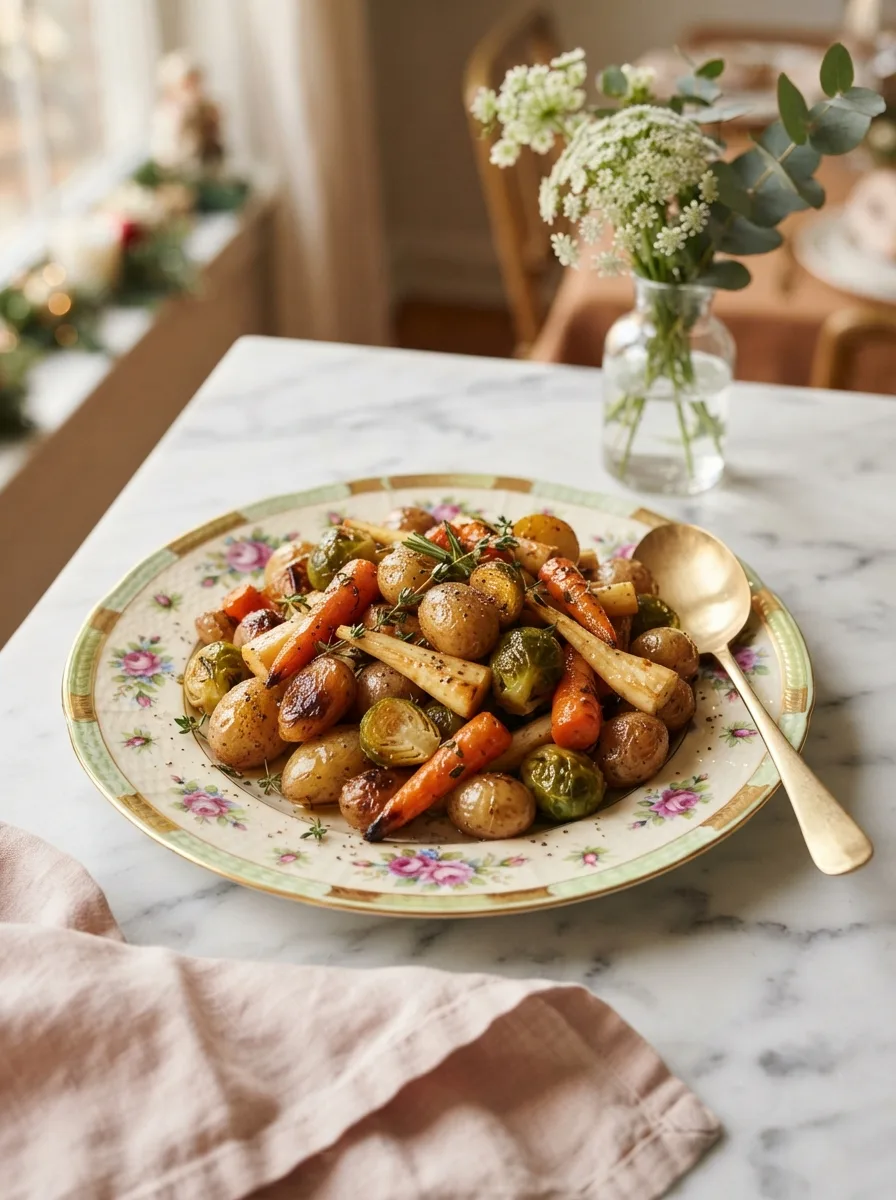
This is the version I now make every year without a second thought — one method, four vegetables, and a glaze that goes on at the very end instead of before roasting, which is the part most Christmas vegetable sides recipes get backwards.
The trade-off: parboiling the dense roots adds an extra pot to wash. I think it’s worth it. Skipping that step is the single biggest reason roasted root vegetables turn out chalky in the center while the outside burns.
★★★★★ “I made a double batch for Christmas dinner and there wasn’t a single carrot left — even my picky nephew went back for seconds.” — Rachel T., recipe tester (pre-launch)
Why You’ll Love These Christmas Vegetable Sides Recipes
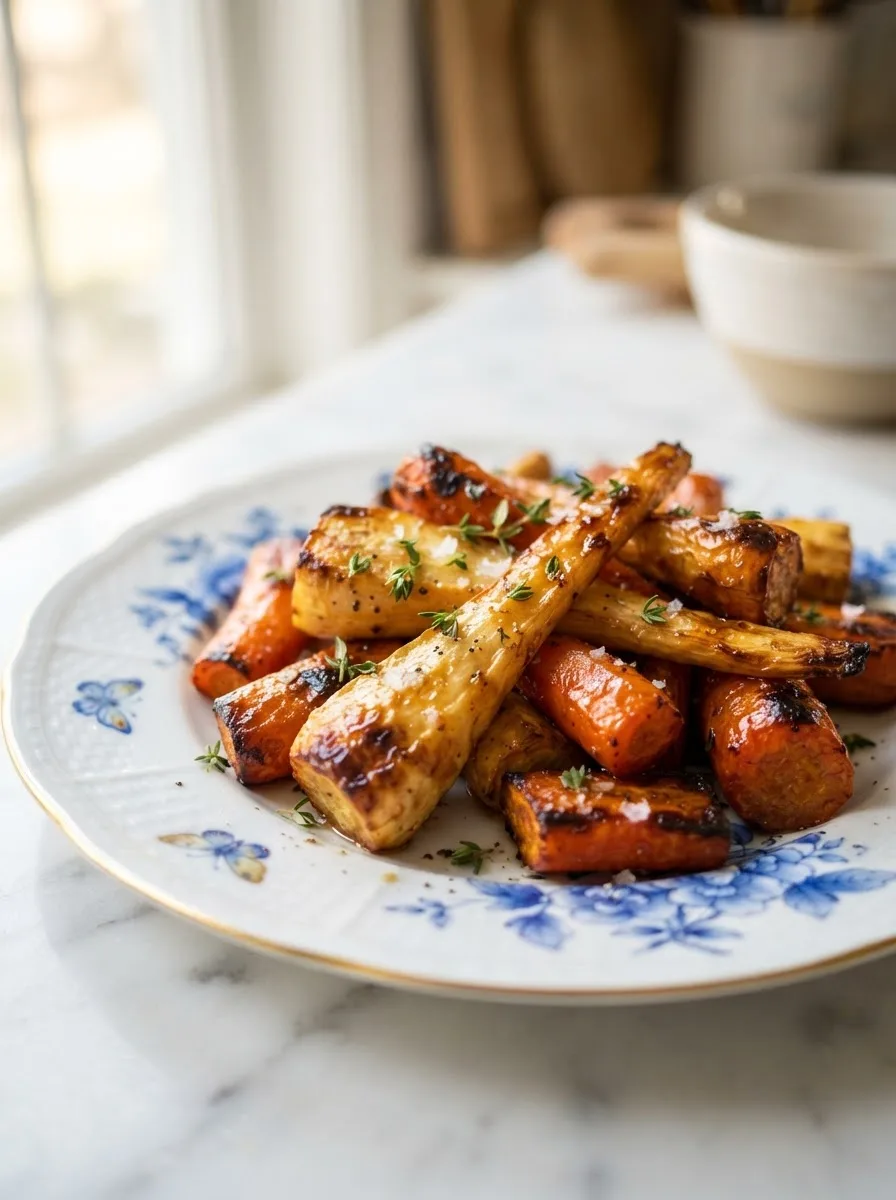
- Real caramelization, not steamed vegetables: The two-pan spacing method means every piece actually browns instead of sweating in its own moisture.
- One glaze, four vegetables: You make a single honey-butter glaze and toss everything in it at the end — no separate seasoning for each vegetable.
- Make-ahead friendly: The vegetables can be cut and parboiled up to two days ahead, which matters more on Christmas than any other day of the year.
- Feeds a crowd without extra work: This recipe scales to two full sheet pans as written, and doubles cleanly for a table of 12–16.
Key Ingredients
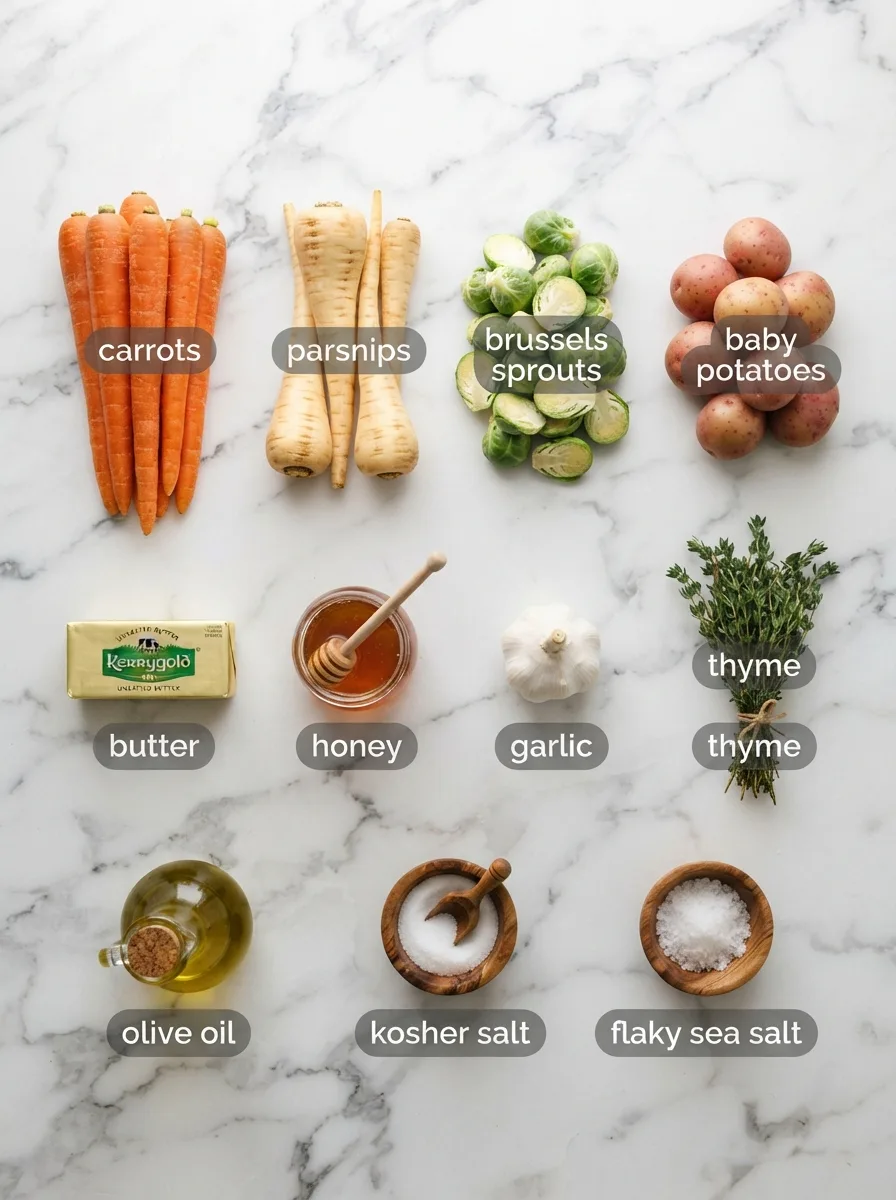
Carrots and parsnips (1½ lbs each). These cook at nearly the same rate and hold their shape well after parboiling, which is why they anchor the whole medley. Cut them into similarly sized batons so nothing finishes early or late.
Brussels sprouts (1 lb, halved). Sprouts go in later than the roots — they burn bitter if they spend the full roast time in a hot oven. Frozen sprouts work in a pinch, but thaw and pat them very dry first or they’ll steam instead of char.
Baby potatoes (1½ lbs, halved). Skip peeling. The skins crisp beautifully and hold the glaze better than peeled potato flesh does.
Unsalted butter (4 tbsp) and honey (3 tbsp). This pair makes the glaze — butter for richness, honey for the caramelized shine. Using salted butter here makes the glaze too salty once it reduces; stick with unsalted and season separately.
Fresh garlic and thyme. Garlic goes into the oil before roasting; thyme is stirred in raw at the very end so it stays bright instead of turning bitter and dark.
Olive oil, kosher salt, flaky sea salt. Olive oil for roasting, kosher salt for seasoning throughout, and a finishing sprinkle of flaky sea salt right before serving — that last touch makes a bigger difference than it should.
Ingredient Note: Cut every root vegetable to roughly the same thickness (about ¾ inch). Uneven cuts are the most common reason one part of the pan is mush while another is still raw — more common than oven temperature, actually.
Equipment You’ll Need
- Two rimmed sheet pans — this is the non-negotiable part of the whole recipe. One overcrowded pan is the difference between roasted and steamed vegetables.
- A large stockpot — for parboiling the carrots, parsnips, and potatoes. Any large pot works.
- Tongs — for tossing vegetables on the hot pans halfway through roasting.
- A small saucepan — for the honey-butter glaze. A skillet works too if that’s what you have.
- A large mixing bowl — for tossing the roasted vegetables in the glaze at the end.
Controlling Caramelization: Pan Density (A Controlled Test)
I tested this recipe on one crowded sheet pan, one spaced sheet pan, and two spaced sheet pans — same oven, same temperature, same vegetables, same amount of time.
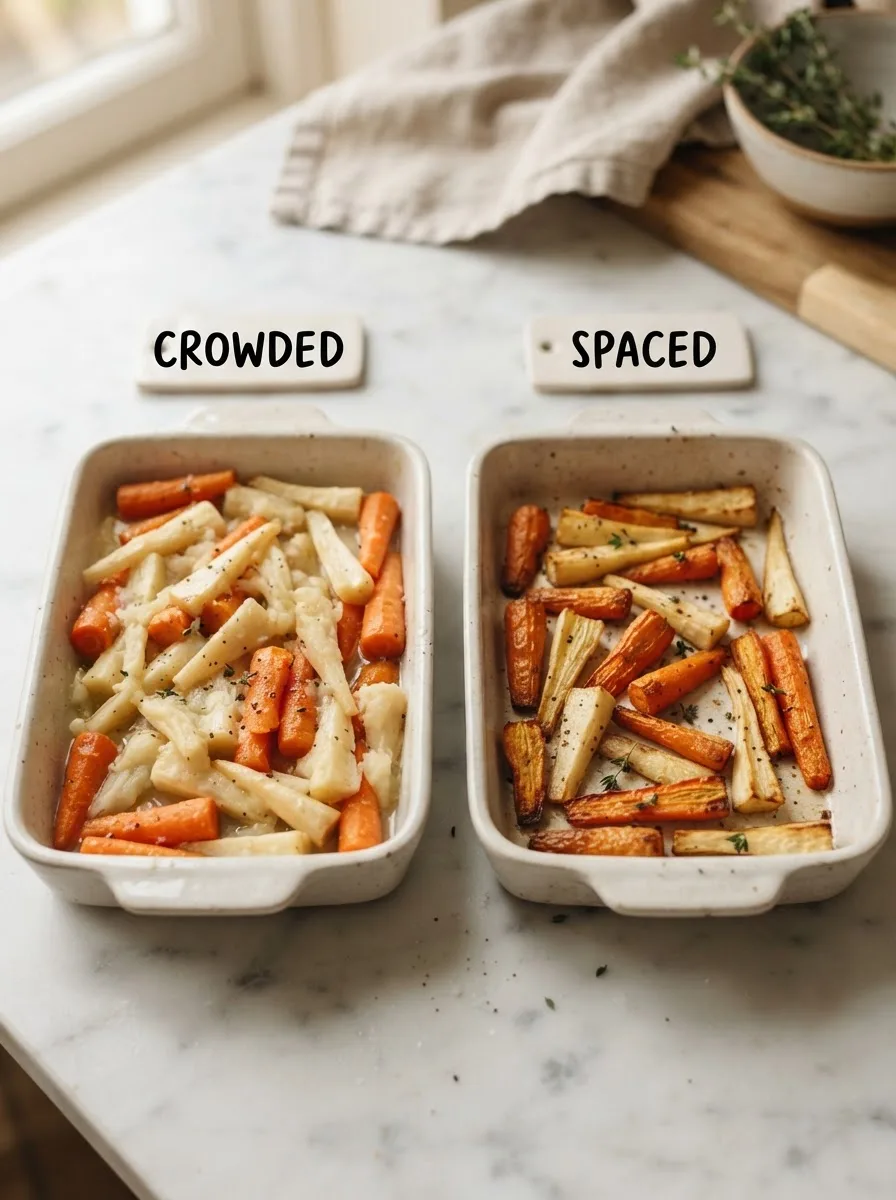
One crowded pan: vegetables released steam into each other and stayed pale. The bottoms of the pieces touching the pan browned slightly, but most of each piece stayed soft and slightly gray.
One spaced pan: noticeably better, but still touching in a few spots, and those spots stayed soft.
Two spaced pans: every piece had room for the steam to escape, and every piece caramelized evenly on at least two sides. This is the version in the recipe below.
The takeaway: if you only have one sheet pan, roast in two batches rather than crowding one pan. It takes a little longer, but the texture difference is not subtle — it’s the whole point of a “roasted” vegetable side.
How to Make Christmas Vegetable Sides
Before you start: Preheat your oven to 425°F and set two racks to the upper-middle and lower-middle positions. Bring a large pot of salted water to a boil before you start cutting vegetables — this saves real time.
Step 1 — Cut the vegetables into even pieces
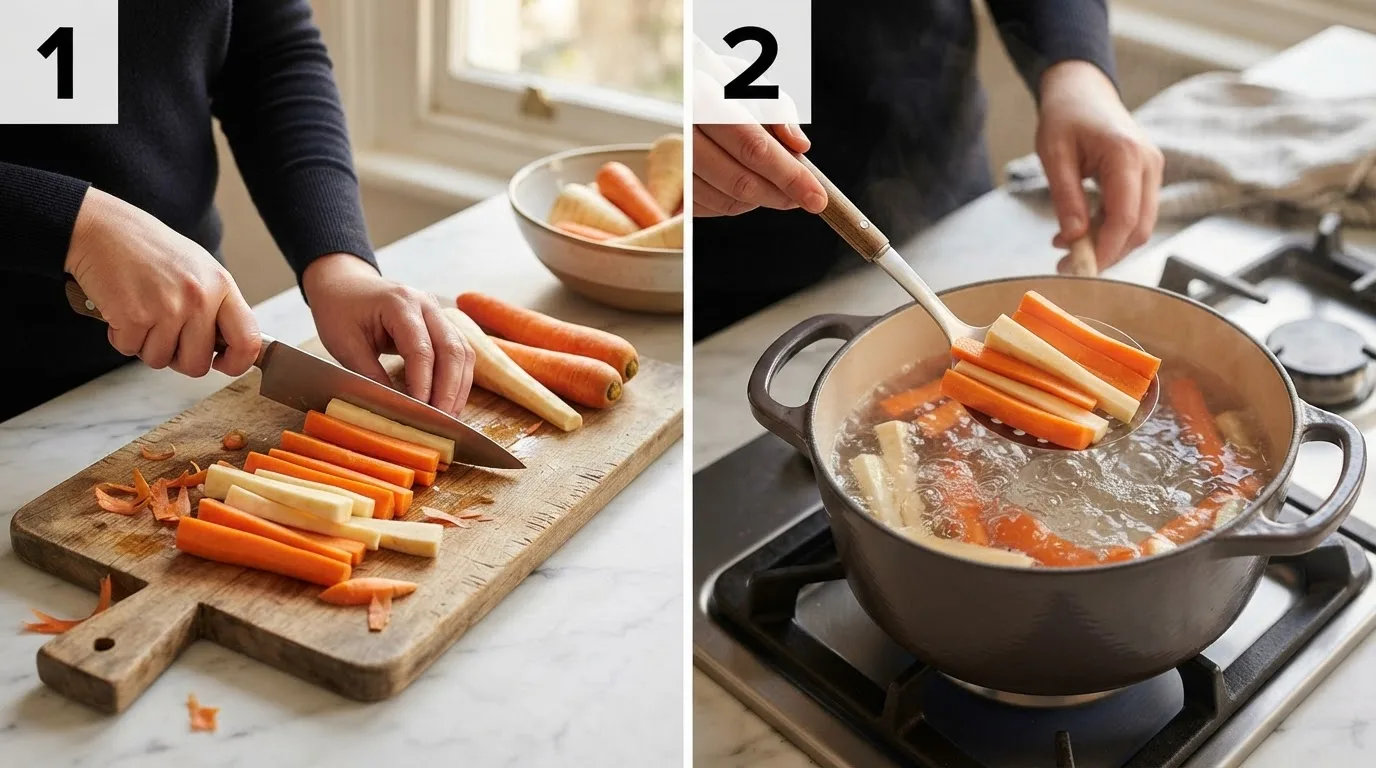
Peel the carrots and parsnips, then cut them into batons roughly ¾ inch thick. Halve the potatoes and the Brussels sprouts. Keep the Brussels sprouts separate from the roots — they go into the oven later.
Step 2 — Parboil the carrots, parsnips, and potatoes
Drop the carrots, parsnips, and potatoes into the boiling water and cook for exactly 4 minutes. Drain well and pat completely dry with a clean towel — any surface moisture left on the vegetables will steam instead of roast.
Step 3 — Toss with oil and garlic, then spread across two pans
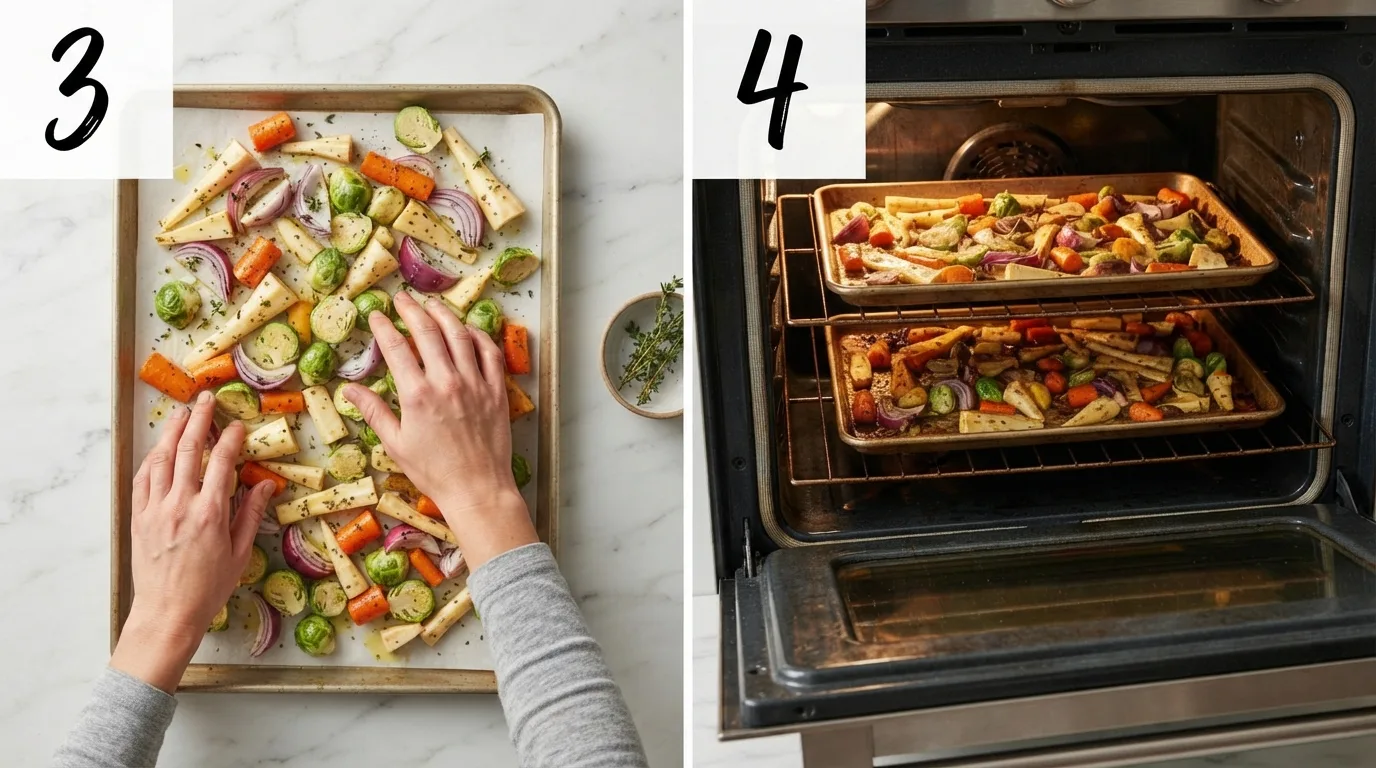
In a large bowl, toss the parboiled vegetables with 3 tablespoons of olive oil, the minced garlic, and 1½ teaspoons of kosher salt. Divide evenly between two rimmed sheet pans, spacing every piece so it isn’t touching another. This spacing is the most important step in the whole recipe.
Step 4 — Roast the first pass
Roast for 20 minutes, swapping the pans between racks halfway through so both get even heat. You’re looking for the bottoms to start turning golden brown at the edges.
Step 5 — Add the Brussels sprouts
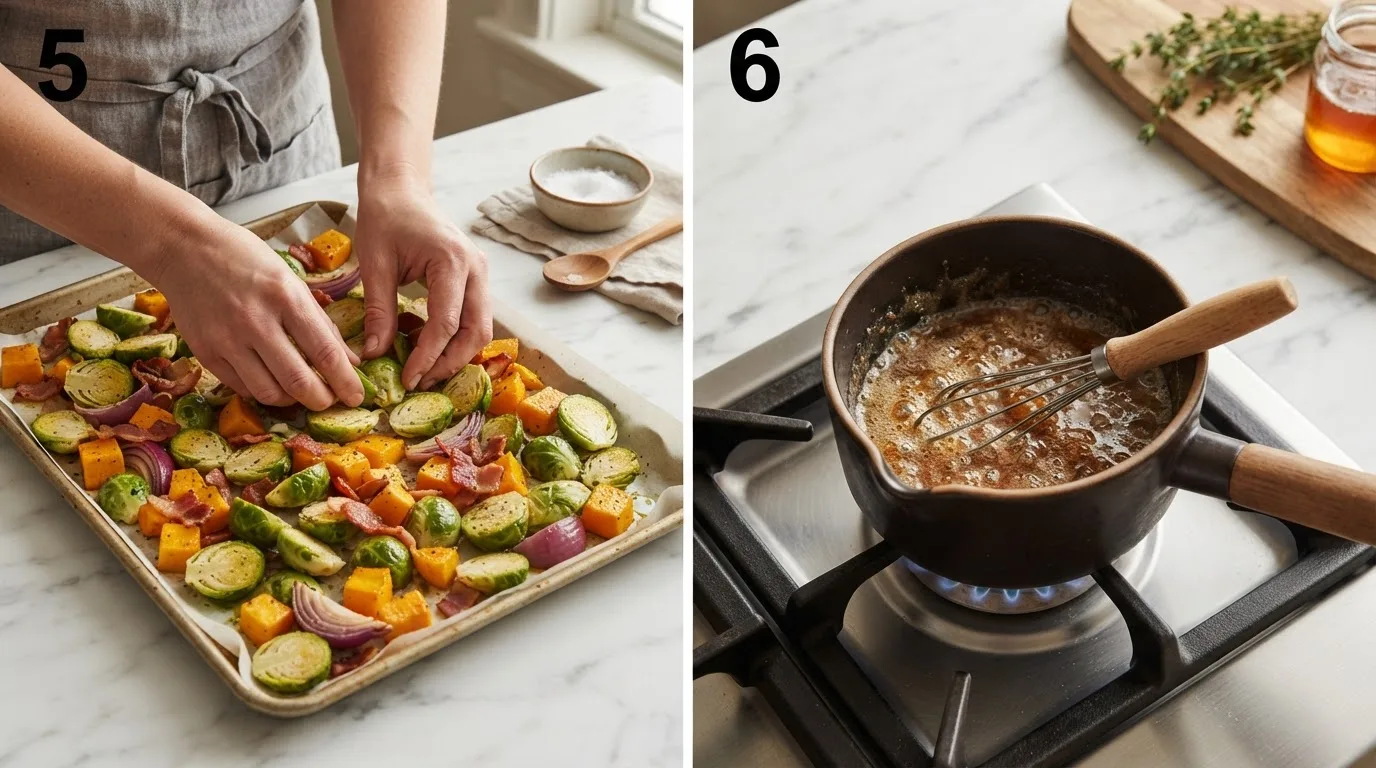
Toss the halved Brussels sprouts with 1 tablespoon of olive oil and a pinch of salt. Tuck them into the gaps on both pans and continue roasting for another 15–18 minutes, until the sprouts are charred at the cut edges and the roots are deeply golden.
Step 6 — Make the honey-butter glaze
While the vegetables finish roasting, melt the butter in a small saucepan over medium-low heat. Stir in the honey and a pinch of salt, and simmer for 2–3 minutes until it thickens slightly and smells toasted rather than sharp. Take it off the heat — if it sits too long it will darken past golden into bitter.
Step 7 — Glaze and finish
Transfer all the roasted vegetables to a large bowl. Pour the warm honey-butter glaze over them and toss gently until everything is coated. Stir in the fresh thyme leaves and finish with a sprinkle of flaky sea salt right before serving.
Pro Tips for Perfect Christmas Vegetable Sides
Tip 1: Dry the vegetables completely after parboiling. Any leftover water on the surface turns to steam in the oven, and steam is what keeps vegetables pale instead of caramelized. A few extra minutes with a towel makes a real difference.
Tip 2: Don’t glaze too early. If you toss the vegetables in the honey butter before they’re fully roasted, the sugar in the honey burns before the vegetables finish cooking. Always glaze at the very end, off the heat.
Tip 3: Stagger the Brussels sprouts. Adding them at the same time as the roots means they either burn black before the carrots are done, or the carrots stay underdone waiting for the sprouts. Fifteen minutes later is the sweet spot.
Tip 4: Salt in stages, not all at once. Salt the vegetables before roasting, then again lightly with the glaze, then finish with a pinch of flaky salt. One big dump of salt at the start tends to oversalt the outside while the inside stays under-seasoned.
Variations and Substitutions
Dietary Variations:
- Vegan: Swap the butter for an equal amount of refined coconut oil or a plant-based butter, and use maple syrup in place of the honey. The glaze thins slightly and the flavor turns a touch less floral, but it still clings and caramelizes well.
- Dairy-free: Same swap as above — coconut oil or a dairy-free butter alternative works cleanly here since the butter is only in the glaze, not in the roasting step.
Flavor Variations:
- Jerk-spiced vegetables: Toss the roasted vegetables with 2 tablespoons of my Jamaican jerk seasoning instead of the honey-butter glaze for a smoky, spiced version that holds up well next to a roast.
- Curry-spiced vegetables: Stir 2 tablespoons of my tikka paste into the melted butter instead of honey for a warm, curried version of this same roasting method.
Ingredient Substitutions:
- Swap the baby potatoes for sweet potatoes, cut to the same size — they parboil and roast at a nearly identical rate.
- Swap parsnips for turnips if parsnips aren’t available; turnips take slightly longer to caramelize, so add 3–5 extra minutes to the first roast.
- Leftover raw parsnip trimmings don’t need to go to waste — they’re the base of my parsnip and leek soup, which is a good way to use the odd ends and peels from this recipe.
Troubleshooting
Why did my roasted vegetables turn out soggy instead of caramelized?
Most likely, the pan was too crowded, or the vegetables weren’t dried well enough after parboiling. Either issue traps steam against the vegetables instead of letting hot, dry air reach the surface. Spread vegetables so they aren’t touching, and pat them fully dry before they go on the pan.
My Brussels sprouts turned bitter and almost black — what happened?
This happens when sprouts go into the oven at the same time as the roots and spend the full roast time in a hot oven. The cut edges char past caramelized into burnt. Add sprouts partway through the roast instead of at the start, and watch them in the last 5 minutes — they go from perfect to burnt quickly.
The glaze didn’t stick — the vegetables looked wet, not glazed?
If the vegetables are still very hot and steaming when you add the glaze, the honey butter can separate and pool instead of clinging. Let the vegetables sit for 1–2 minutes off the heat before tossing them in the glaze, and make sure the glaze itself has reduced slightly rather than being thin and watery.
Storage and Make-Ahead
Counter: These are best served within 2 hours of roasting; the caramelized edges soften as they sit at room temperature.
Refrigerator: Store in an airtight container for up to 4 days. The texture softens somewhat but the flavor holds well.
Freeze: Not recommended once glazed — the honey butter separates on thawing and the vegetables turn mushy. If you want to freeze ahead, freeze the plain roasted vegetables (before glazing) for up to 2 months, and make the glaze fresh when reheating.
Reheating: Spread leftovers on a sheet pan and reheat at 400°F for 8–10 minutes to recrisp the edges. A microwave will heat them through but leaves them soft.
Make-Ahead: Cut and parboil the carrots, parsnips, and potatoes up to 2 days ahead, and store them dried and covered in the refrigerator. Roast and glaze fresh on the day you’re serving — this is the single biggest time-saver for a Christmas dinner timeline.
Frequently Asked Questions
Q: Can I make Christmas vegetable sides ahead of time? A: Yes — parboil and cut the root vegetables up to 2 days in advance and refrigerate them dried and covered. Roast and glaze them fresh the day you serve, since the caramelized texture doesn’t hold up well if roasted too far ahead.
Q: Why did my roasted vegetables turn out mushy instead of crisp? A: Overcrowded pans and leftover surface moisture are the two most common causes. Give every piece room to breathe on the pan, and dry vegetables thoroughly after parboiling.
Q: Can I use frozen vegetables for this recipe? A: Frozen Brussels sprouts work if thawed and patted very dry first. Frozen carrots and parsnips tend to turn watery and don’t caramelize well — fresh is worth it for the roots.
Q: What vegetables work best for Christmas vegetable sides recipes? A: Carrots, parsnips, Brussels sprouts, and baby potatoes hold up best to high-heat roasting and pair naturally with a honey-butter glaze. Sweet potatoes and turnips both substitute well if you want variety.
Q: Can I make this vegan? A: Yes — swap the butter for coconut oil or a plant-based butter and use maple syrup instead of honey. The result caramelizes just as well, with a slightly less floral flavor.
Q: How do I reheat leftovers without drying them out? A: Reheat on a sheet pan at 400°F for 8–10 minutes rather than in the microwave. The dry oven heat recrisps the edges instead of steaming the vegetables soft.
Q: Can I double this recipe for a larger crowd? A: Yes, it doubles cleanly — just keep the same pan-spacing rule and use four sheet pans instead of two rather than crowding fewer pans.
Q: What should I serve alongside these vegetable sides? A: They pair well with roasted meats, and the honey-butter flavor also works nicely spooned over warm flatbread like my Jamaican roti if you’re building a mixed holiday spread.
More Recipes You’ll Love
- Jamaican Jerk Seasoning — the smoky, spiced blend used in the jerk-roasted vegetable variation above
- Tikka Paste — the warm curry base for the curried vegetable variation
- Parsnip and Leek Soup — a good way to use leftover parsnip trimmings from this recipe
- Jamaican Roti — a soft flatbread that pairs well with these vegetables for a mixed holiday table
Foolproof Christmas Vegetable Sides Recipes
Ingredients
For the Vegetables:
- 11/2 lb carrots, peeled and cut into ¾-inch batons
- 11/2 lb parsnips, peeled and cut into ¾-inch batons
- 11/2 lb baby potatoes, halved
- 1 lb Brussels sprouts, halved
- 4 tbsp olive oil, divided
- 3 clove garlic, minced
- 2 tsp kosher salt, divided
For the Honey-Butter Glaze:
- 4 tbsp unsalted butter
- 3 tbsp honey
- 1 tbsp fresh thyme leaves
- Flaky sea salt, for finishing
Instructions
- Preheat the oven to 425°F. Bring a large pot of salted water to a boil.
- Cut the carrots and parsnips into ¾-inch batons. Halve the potatoes and Brussels sprouts, keeping the sprouts separate.
- Boil the carrots, parsnips, and potatoes for exactly 4 minutes. Drain and pat completely dry.
- Toss the parboiled vegetables with 3 tablespoons olive oil, the garlic, and 1½ teaspoons kosher salt. Spread evenly across two rimmed sheet pans, spacing every piece so it isn’t touching another.
- Roast for 20 minutes, swapping the pans between oven racks halfway through.
- Toss the Brussels sprouts with the remaining 1 tablespoon olive oil and remaining ½ teaspoon salt. Tuck into the gaps on both pans and roast another 15–18 minutes, until roots are deeply golden and sprouts are charred at the edges.
- While the vegetables finish, melt the butter in a small saucepan over medium-low heat. Stir in the honey and a pinch of salt, and simmer 2–3 minutes until slightly thickened.
- Transfer the roasted vegetables to a large bowl. Pour the warm glaze over them and toss gently to coat.
- Stir in the fresh thyme and finish with a sprinkle of flaky sea salt just before serving.
Notes
- Cut all root vegetables to the same thickness (about ¾ inch) — uneven cuts are the most common cause of unevenly cooked vegetables.
- Do not skip parboiling the carrots, parsnips, and potatoes — this is what keeps the centers tender while the outsides caramelize.
- Dry the vegetables thoroughly after parboiling; leftover surface moisture steams instead of roasts.
- Use two sheet pans, not one — crowding is the single biggest cause of soft, pale vegetables.
- Add the Brussels sprouts partway through roasting, not at the start, to prevent bitter, over-charred sprouts.
- Glaze the vegetables off the heat, after roasting — glazing too early burns the honey before the vegetables finish cooking.
- For a vegan version, substitute coconut oil for butter and maple syrup for honey in the glaze.
- Leftovers keep in the refrigerator for up to 4 days in an airtight container.
- Reheat on a sheet pan at 400°F for 8–10 minutes to recrisp the edges; microwaving will soften them.
- Freeze only the unglazed roasted vegetables, for up to 2 months — glazed vegetables separate and turn mushy after freezing.
- To make ahead, parboil and refrigerate the cut root vegetables (dried, covered) up to 2 days before roasting.
- This recipe doubles cleanly for a crowd — use four sheet pans rather than crowding fewer pans when doubling.