Foolproof Tom Nichols Lamb Recipe

The first time I roasted a leg of lamb on my own, I nearly gave up on lamb entirely. It came out gray edge to edge, chewy in the middle, and about as exciting as an old shoe. Then my neighbor Tom Nichols invited me over for Easter and set me straight.
Tom has been roasting lamb for his family’s holiday table for longer than I’ve lived on this street, and the method he showed me changes everything: a garlic-anchovy rub, a slow start in a low oven, and a hot finish at the end. I tested his approach four times to nail the timing for a normal home oven, not a restaurant range.
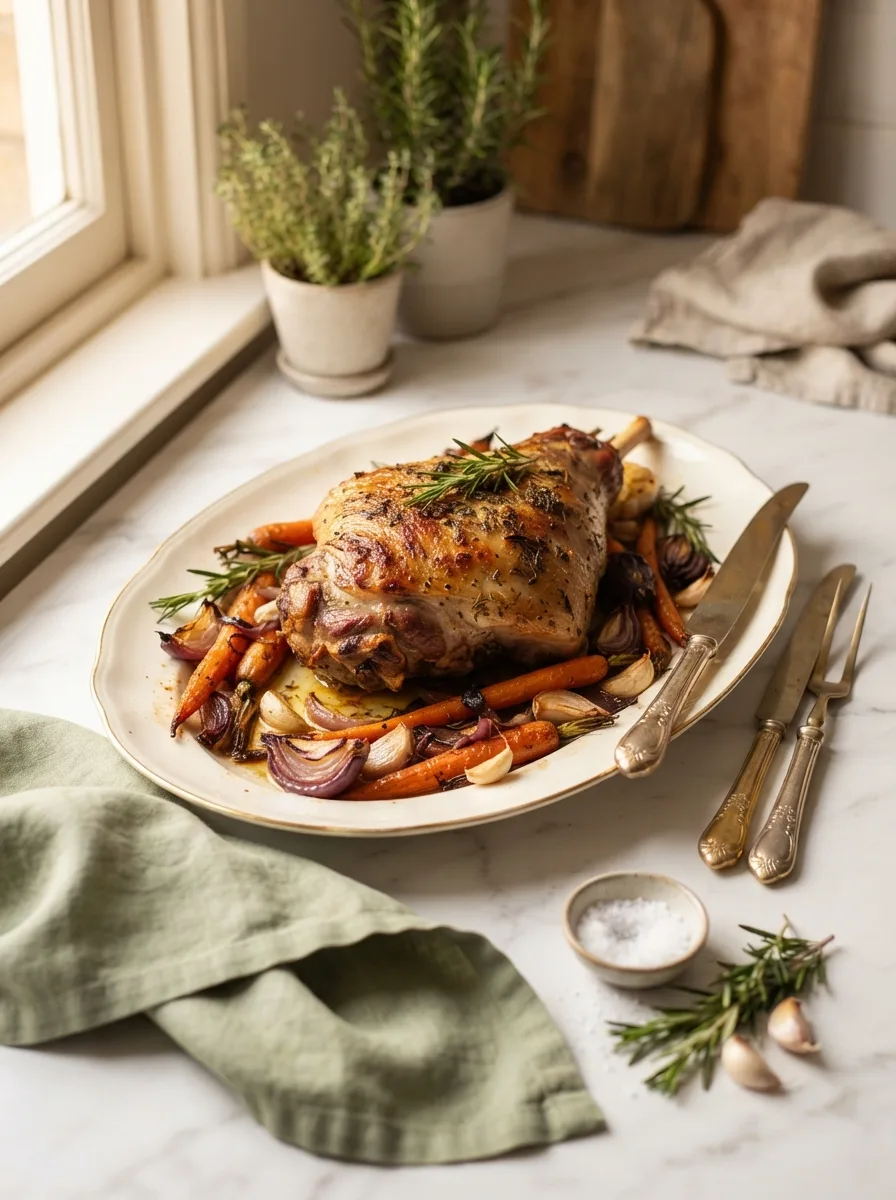
The result is a roast with a deep golden crust, a rosy pink center edge to edge, and a garlicky pan jus you’ll want to drink straight from the spoon. This is the Tom Nichols Lamb Recipe I reach for whenever I genuinely need it to work.
★★★★★ “I don’t even really like lamb, and I went back for seconds. The crust alone is worth making this.” — Dana R., recipe tester (pre-launch)
Why You’ll Love This Tom Nichols Lamb Recipe
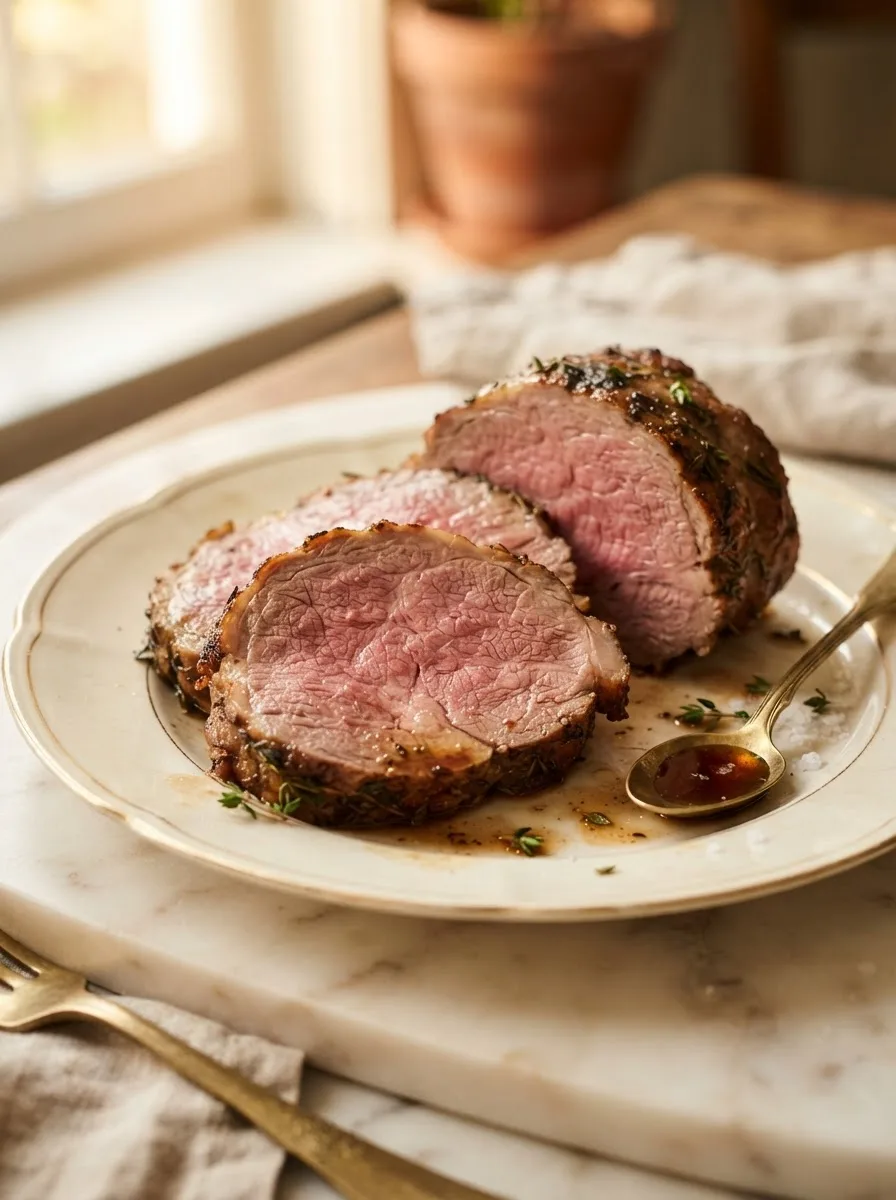
- Edge-to-edge pink, not a gray ring: The reverse-sear method means the whole roast comes to temperature evenly, so you’re not carving off a gray band just to find the pink center.
- A crust that actually crackles: The final high-heat blast browns the outside deeply without drying out the inside — you get real texture contrast in every slice.
- Mostly hands-off cook time: Once the lamb is rubbed and in the oven, you have almost two hours to do everything else for the meal.
- Built for a crowd: This scales cleanly for a holiday table — the timing and temperature stay the same whether you’re feeding 6 or 10.
Key Ingredients
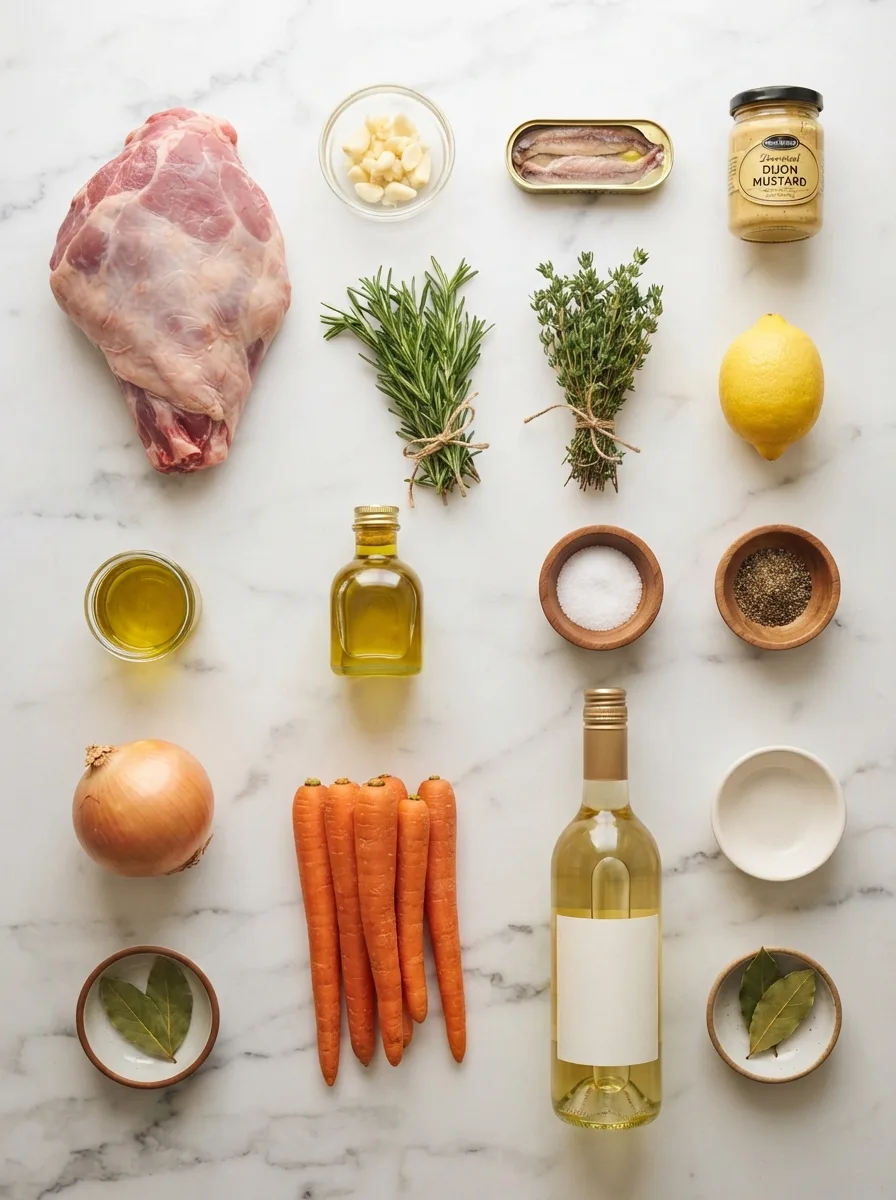
Boneless leg of lamb (4–5 lbs). Boneless is easier to tie into an even shape, which is what gives you consistent doneness from end to end. A bone-in leg works too — just add 15–20 minutes to the low-roast phase and account for the bone when carving.
Anchovy fillets (2, mashed). This is the ingredient people always question and then never skip again. The anchovy doesn’t taste fishy once it’s cooked into the rub — it dissolves into a deep, savory backbone that makes the lamb taste more like itself, not less. No anchovy on hand? A teaspoon of Worcestershire sauce gets you most of the way there.
Garlic (6 cloves, minced) + Dijon mustard (1 tablespoon). The mustard isn’t for flavor as much as it is for grip — it helps the garlic and herbs cling to the lamb instead of sliding off in the oven, and it contributes to a deeper, more even crust.
Fresh rosemary and thyme. Dried herbs will work in a pinch (use a third of the amount), but fresh herbs chopped fine and pressed into the rub give you visible flecks in the crust, which matters more here than you’d think — it’s half of what makes the finished roast look like it took real effort.
Dry white wine (1 cup, for the pan). The wine deglazes the drippings into a jus you’ll want to pour over everything on the plate. Low-sodium chicken broth is a fine swap if you’d rather skip the alcohol.
Ingredient Note: Salt the lamb the night before if you can. A dry brine — just kosher salt rubbed on and left uncovered in the fridge for 8–24 hours — pulls moisture to the surface, which then gets reabsorbed with the seasoning. It’s the single biggest difference between a good crust and a forgettable one.
Equipment You’ll Need
- Roasting pan with a rack — the rack keeps the lamb out of the pan drippings so the bottom crisps instead of steaming. A sheet pan with a wire rack set inside works just as well.
- Instant-read meat thermometer — this is the one non-negotiable tool. Guessing by time alone is how lamb ends up overcooked.
- Kitchen twine — needed if you’re tying a boneless leg into a compact roast shape. Skip it for bone-in.
- Sharp carving knife and cutting board with a juice groove — a dull knife tears the crust instead of slicing through it cleanly.
Controlling Doneness: Low-and-Slow vs. High-Heat (A Controlled Test)
I tested this roast four separate times, changing only the roasting method each time, to find out which approach actually delivers even color from edge to edge without drying out the center.
Test 1 — High heat the whole time (450°F throughout): Fast, and the crust formed early, but the outer inch of meat was noticeably overcooked and gray by the time the center hit medium-rare.
Test 2 — Low and slow the whole time (300°F throughout): Beautifully even color inside, but the outside stayed pale and never developed real crust, even after 20 extra minutes.
Test 3 & 4 — Reverse sear (300°F, then a 450°F finish): This is the version in the recipe card. Low heat brings the whole roast up to temperature gently and evenly, then a short hot blast at the end builds the crust in the last 10–15 minutes, before the outer meat has time to overcook.
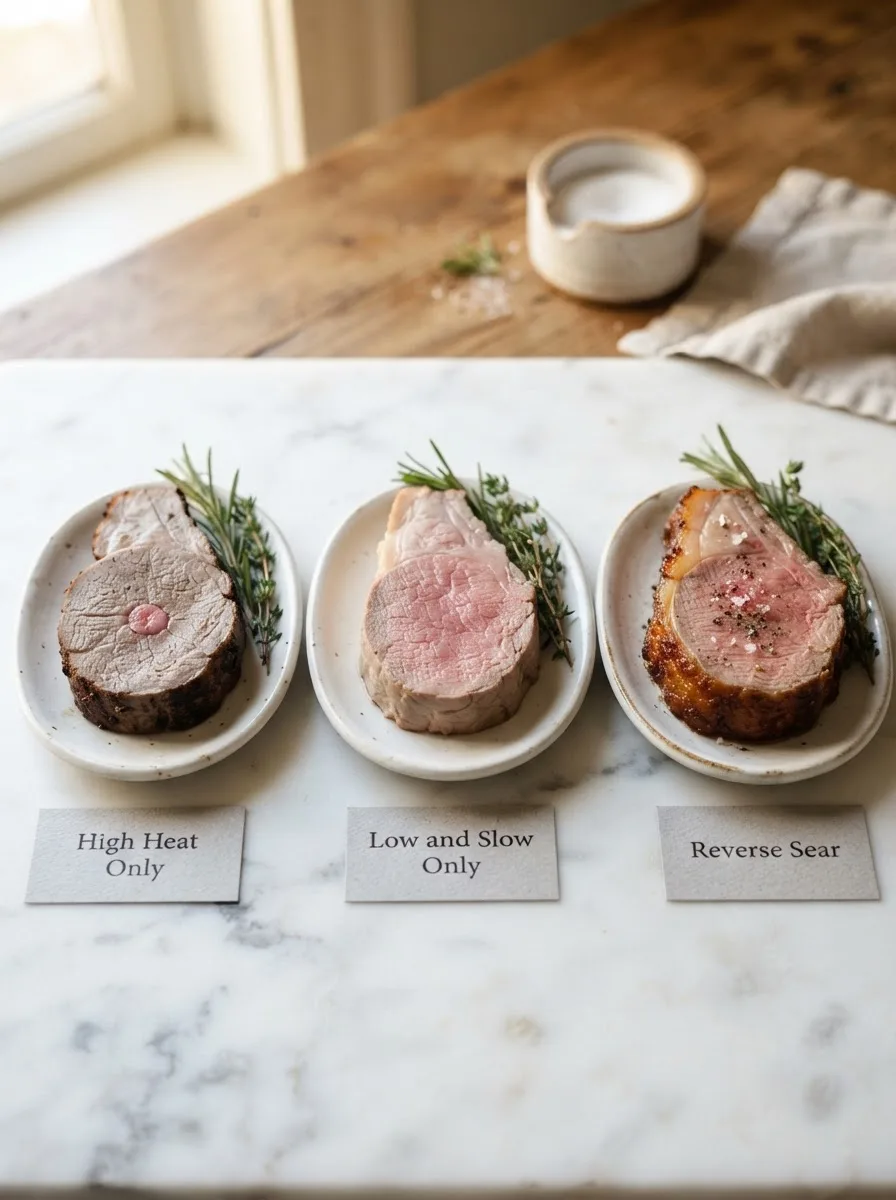
The takeaway: heat strategy matters more than total cook time. If you only remember one thing from this section, remember this — start low, finish hot, and pull the lamb by temperature, not by the clock.
How to Make Tom Nichols Lamb Recipe
Before you start: Take the lamb out of the fridge at least 45 minutes before roasting so it isn’t cold in the center. If you dry-brined overnight, pat it dry before adding the rub — a wet surface won’t brown.
Step 1 — Make the garlic-anchovy paste
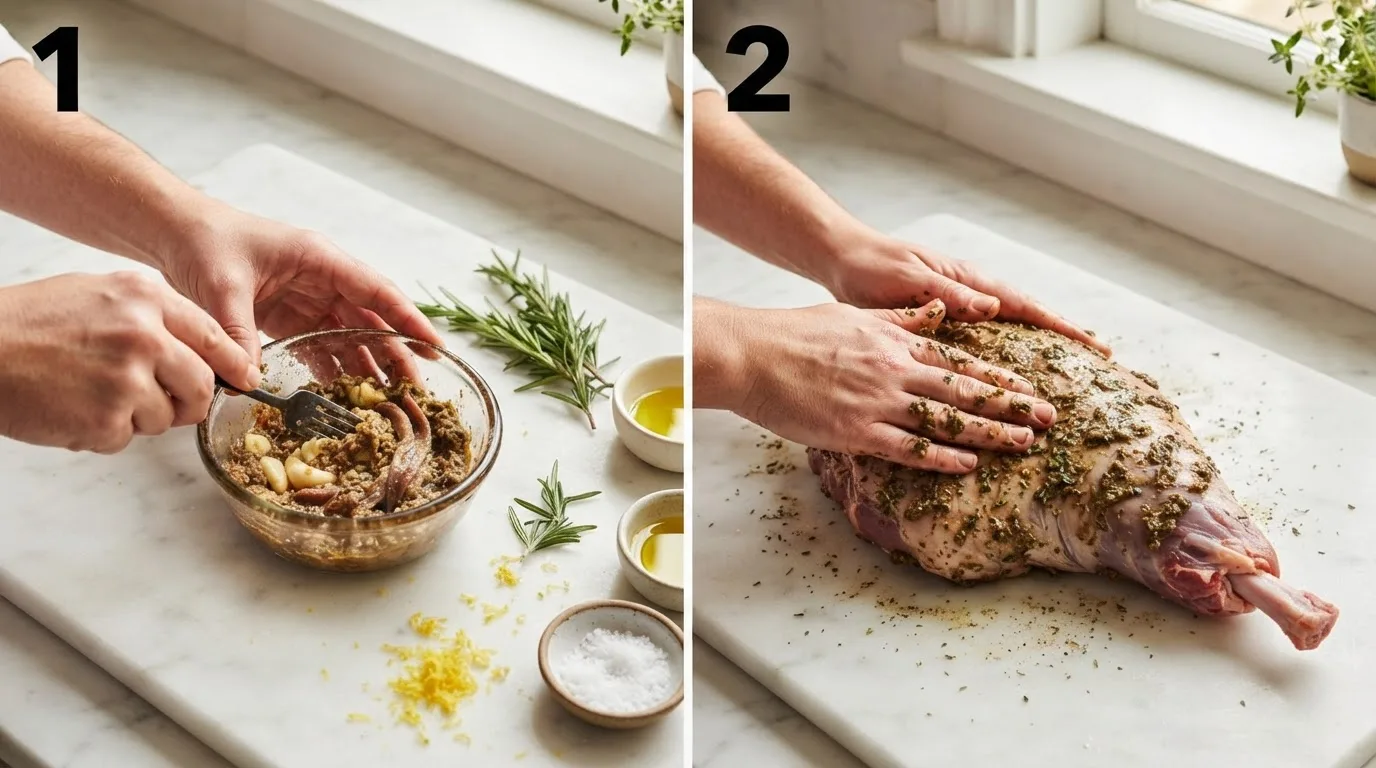
In a small bowl, mash the garlic and anchovy fillets into a rough paste with the back of a fork. Stir in the Dijon mustard, chopped rosemary, thyme, lemon zest, olive oil, and black pepper until it forms a thick, spreadable rub. It won’t look pretty — that’s fine.
Step 2 — Rub and tie the lamb
Rub the paste over every surface of the lamb, including any folds or pockets in a boneless leg — that’s where flavor tends to get missed. If the leg is boneless and butterflied, roll it into a compact shape and tie it with kitchen twine every 1–2 inches so it roasts evenly instead of flattening out in the pan.
Step 3 — Arrange the pan and preheat
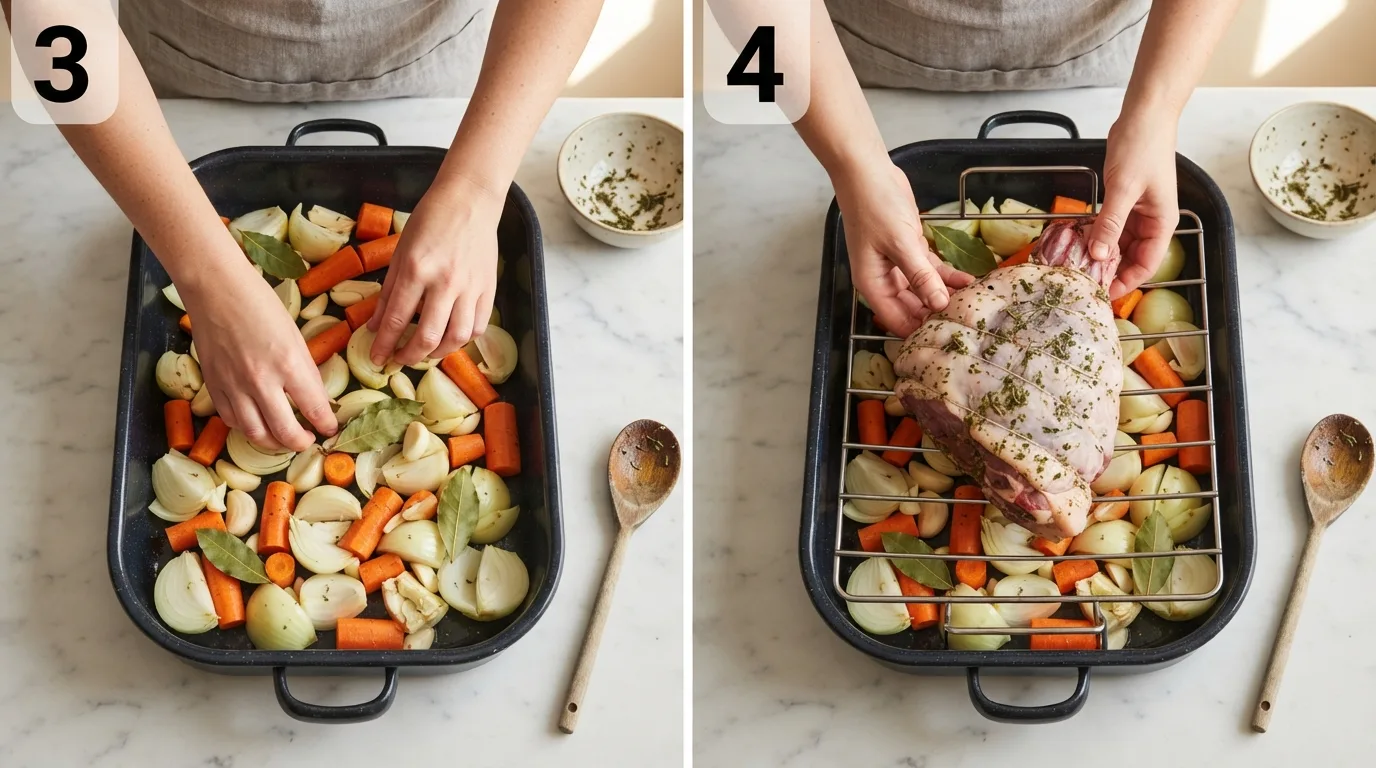
Scatter the sliced onion, carrots, and bay leaves in the bottom of a roasting pan and set a rack on top. Place the lamb on the rack, fat-side up. Preheat the oven to 300°F — a true preheat, not just when the oven beeps.
Step 4 — Roast low and slow
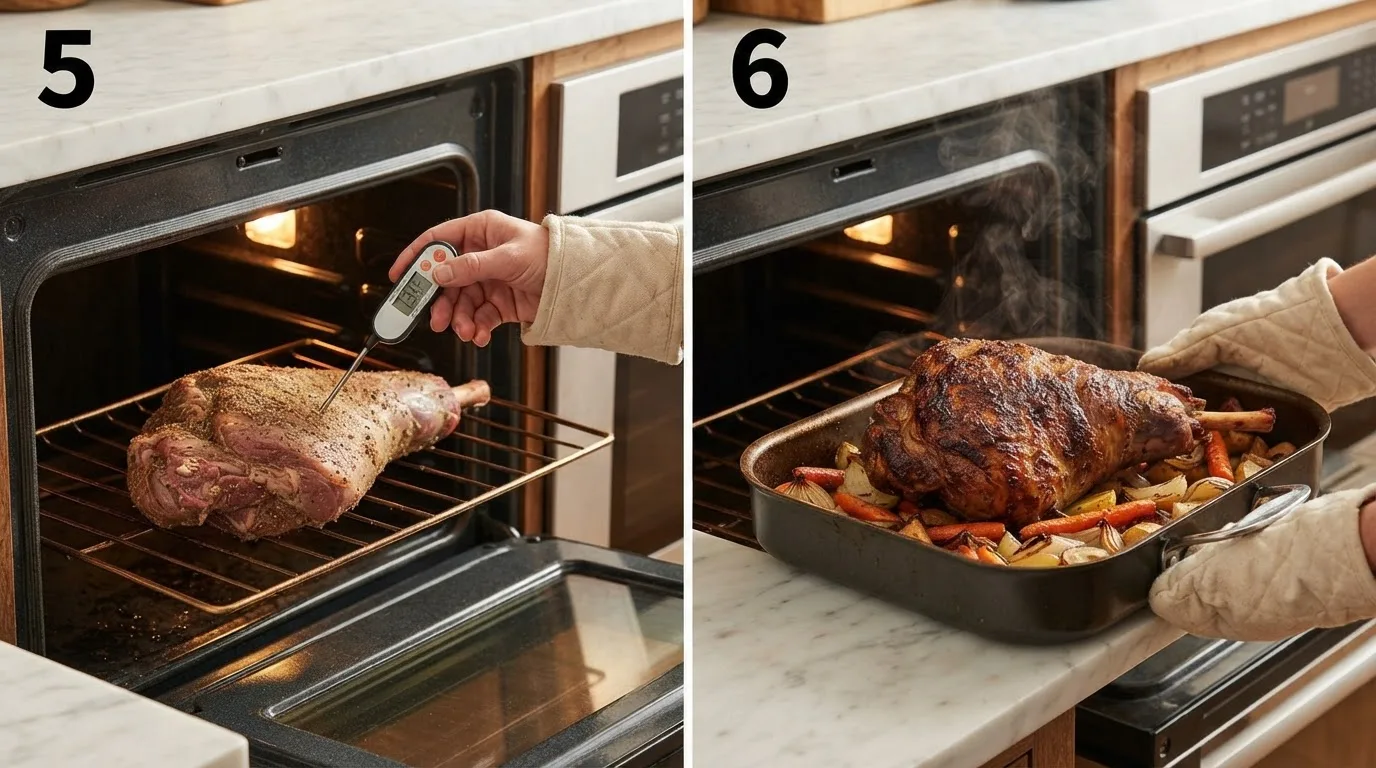
Pour the wine into the pan around the vegetables (not over the lamb) and roast at 300°F. For a 4–5 lb leg, this takes about 90 minutes to reach an internal temperature of 120°F at the thickest part — check with the thermometer starting around the 75-minute mark.
Step 5 — Blast at high heat to finish
Remove the lamb briefly and crank the oven to 450°F. Once it’s fully preheated, return the lamb and roast for another 10–15 minutes, until the crust is deep golden-brown and the internal temperature reaches 125–130°F for medium-rare (135–140°F for medium).
Step 6 — Rest before carving
Transfer the lamb to a cutting board and let it rest, loosely tented with foil, for at least 20 minutes. Don’t skip this — the internal temperature will climb another 5–8 degrees as it rests, and cutting in early is how you lose all the juice onto the board instead of into the meat.
Step 7 — Make the pan jus
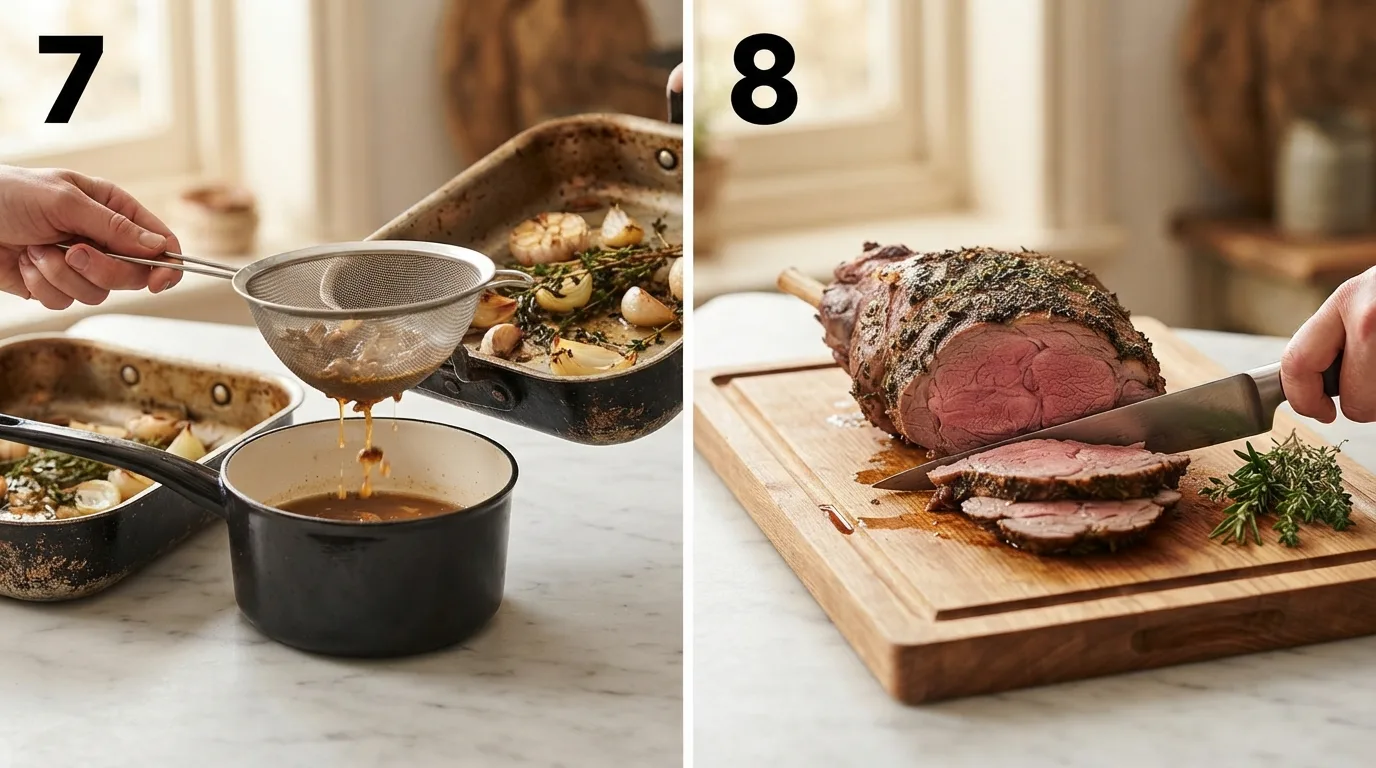
While the lamb rests, strain the pan drippings and vegetables into a small saucepan, pressing the vegetables to extract the liquid, then discard the solids. Simmer for 5 minutes to concentrate the flavor, and season with salt to taste.
Step 8 — Slice and serve
Cut the twine, slice against the grain into thick pieces, and arrange on a platter. Spoon the warm jus over the top just before serving.
Pro Tips for Perfect Lamb
Tip 1: Pull it 5 degrees early. Carryover cooking is real — the internal temperature keeps climbing after the lamb leaves the oven. Pull it at 125°F if you want a finished 130°F medium-rare center.
Tip 2: Tie it tight, not just tied. A loosely tied boneless leg unrolls slightly as it cooks, which throws off even doneness. Tie every 1–2 inches, snug enough that the shape holds when you lift it.
Tip 3: Don’t crowd the pan. If the vegetables are piled too high around the rack, the bottom of the lamb steams instead of roasting. Keep them in a single layer.
Tip 4: Slice against the grain. Lamb muscle fibers run in a clear direction — slicing with them instead of across them makes even a perfectly cooked roast seem chewy.
Variations and Substitutions
Dietary Variations:
- Lower sodium: Cut the added kosher salt by half and lean more on fresh herbs and lemon zest for flavor. The anchovy still carries plenty of savoriness on its own.
- No alcohol: Swap the white wine in the pan for low-sodium chicken broth. The jus will be slightly less complex but still good.
Flavor Variations:
- Greek-style: Add 1 tablespoon dried oregano and the juice of the lemon (not just the zest) to the rub, and serve with a side of garlicky yogurt.
- Middle Eastern-style: Swap the rosemary and thyme for 1 tablespoon each of ground cumin and coriander, plus a teaspoon of sumac.
Ingredient Substitutions:
- No anchovy → 1 teaspoon Worcestershire sauce whisked into the paste
- Boneless leg → bone-in leg of lamb, adding 15–20 minutes to the low-roast phase
If you liked the anchovy-forward savoriness in this rub, the wes canfield smoked salmon recipe leans on a similar salt-and-umami base, just in a completely different direction.
Troubleshooting
Why is my lamb tough or chewy?
This is almost always either overcooking past medium, or slicing with the grain instead of against it. Lamb leg is a lean-ish roasting cut — once it passes about 140°F internal, it starts drying out fast. Pull it earlier next time and double-check which direction the muscle fibers run before you carve.
Why didn’t I get a good crust?
The most common cause is an oven that wasn’t fully at 450°F when the lamb went back in for the finish — ovens lag behind what the display says, especially after being opened. Give it a full 10–15 minutes to actually reach temperature. A crowded pan with too much liquid underneath the rack can also steam the surface instead of browning it.
Why is the center gray instead of pink?
Usually this means the lamb was pulled too early without accounting for carryover cooking, or it wasn’t rested before slicing. Cutting into a hot roast releases the juices and can make the center look duller than it actually is. Use a thermometer, and give it the full 20-minute rest.
Storage and Make-Ahead
Counter: Don’t leave cooked lamb at room temperature longer than 2 hours.
Refrigerator: Store sliced or whole lamb in an airtight container for up to 4 days.
Freeze: Sliced lamb freezes well for up to 3 months. Wrap tightly and thaw overnight in the fridge before reheating.
Reheating: Warm gently, covered, in a 300°F oven with a splash of broth or the reserved jus to keep it from drying out. Avoid the microwave if you can — it toughens the texture fast.
Make-Ahead: Rub the lamb with the paste up to 24 hours ahead and dry-brine, uncovered, in the fridge. Roast it the day you plan to serve it — the actual cooking doesn’t hold well ahead of time.
Frequently Asked Questions
Q: What temperature should lamb be for medium-rare? A: Pull it at 125°F and let it rest — carryover cooking will bring it to a finished 130–135°F, which is medium-rare.
Q: Can I use a bone-in leg of lamb instead? A: Yes. Bone-in takes about 15–20 minutes longer in the low-roast phase, and you’ll need to carve around the bone, but the method is otherwise identical.
Q: How long does it take to roast a 5 lb leg of lamb? A: Plan on roughly 2.5 hours total — about 90 minutes at 300°F, 10–15 minutes at 450°F to finish, and a 20-minute rest before carving.
Q: Do I really need to tie the lamb? A: If it’s boneless and butterflied, yes — an untied leg cooks unevenly because it’s flatter in some spots than others. A bone-in leg doesn’t need tying.
Q: Can I make this ahead for a holiday? A: Dry-brine and rub the lamb up to a day ahead, then roast it the day you’re serving. The roasting itself is best done fresh.
Q: What should I serve with this? A: Roasted potatoes, a simple green salad, and something bright like mint yogurt or a lemony vinaigrette all balance the richness well.
Q: Can I grill this instead of roasting it in the oven? A: Yes — use indirect heat for the low phase, then move it directly over the coals for a few minutes per side to build the crust.
Q: Is lamb the same thing as mutton? A: No. Lamb comes from young sheep and is milder and more tender; mutton comes from older sheep and has a stronger flavor and tougher texture.
More Main Dish Recipes You’ll Love
- Sovitika Poyivia Recipe — another slow-cooked, herb-forward main worth putting on your holiday rotation.
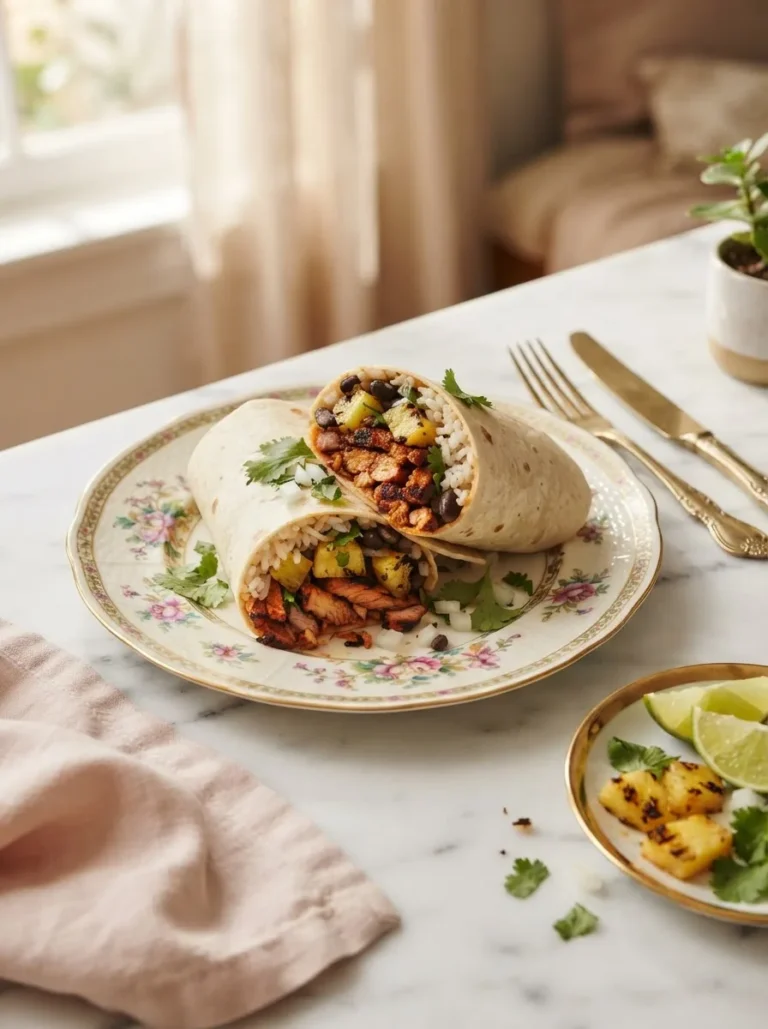
- El Pastor Burrito — if you want something faster and weeknight-friendly after a big roast weekend.
- Wes Canfield Smoked Salmon Recipe — a completely different protein with a similar salt-forward, savory approach.
- Chicken Modiga — a lighter, quicker main for nights when a two-hour roast isn’t in the cards.
Foolproof Tom Nichols Lamb Recipe
Ingredients
For the lamb:
- 1 boneless leg of lamb, 4–5 lbs, trimmed
- 2 tablespoon kosher salt
- 1 tablespoon Dijon mustard
- 6 clove garlic, minced
- 2 anchovy fillets, mashed (or 1 teaspoon anchovy paste)
- 3 tablespoon fresh rosemary, finely chopped
- 2 teaspoon fresh thyme, finely chopped
- Zest of 1 lemon
- 1/4 cup olive oil
- 1 teaspoon black pepper
For the pan:
- 1 yellow onion, sliced
- 4 carrots, halved lengthwise
- 1 cup dry white wine (or low-sodium chicken broth)
- 2 bay leaves
Instructions
- If time allows, salt the lamb with the kosher salt the night before and refrigerate uncovered for 8–24 hours as a dry brine. Pat dry before continuing.
- Bring the lamb to near room temperature, about 45 minutes before roasting.
- In a small bowl, mash the garlic and anchovy into a paste with a fork. Mix in the Dijon mustard, rosemary, thyme, lemon zest, olive oil, and black pepper until combined.
- Rub the paste over every surface of the lamb, including any folds. If boneless and butterflied, roll into a compact shape and tie with kitchen twine every 1–2 inches.
- Preheat the oven to 300°F. Scatter the onion, carrots, and bay leaves in a roasting pan, set a rack on top, and place the lamb on the rack, fat-side up. Pour the wine into the pan around the vegetables.
- Roast at 300°F for about 90 minutes, until the internal temperature reaches 120°F at the thickest part.
- Remove the lamb and increase the oven temperature to 450°F. Once fully preheated, return the lamb and roast for 10–15 minutes, until the crust is deep golden-brown and internal temperature reaches 125°F (for a finished medium-rare).
- Transfer to a cutting board, tent loosely with foil, and rest for 20 minutes.
- Strain the pan drippings and vegetables into a saucepan, pressing to extract liquid; discard solids. Simmer 5 minutes and season with salt to taste.
- Remove the twine, slice the lamb against the grain into thick pieces, and serve with the warm jus spooned over top.
Notes
- Dry-brining the lamb uncovered in the fridge for up to 24 hours deepens both the crust and the seasoning — worth doing if you have the time.
- Use a meat thermometer rather than relying on time; pull the lamb about 5°F below your target since it keeps cooking during the rest.
- Leftover sliced lamb freezes well for up to 3 months; thaw overnight in the fridge before reheating gently with a splash of broth.
- If using a bone-in leg instead of boneless, add 15–20 minutes to the initial low-roast phase.
- A boneless leg tied into a compact, even shape roasts far more evenly than one left loose and flat in the pan.
- Strain the herbs and bay leaves out of the pan drippings before simmering the jus, or the flavor turns bitter.## More Recipes You'll Love